Sunday, March 30, 2014

TOW #23 - Article: "Vertical Farming Explained: How Cities Could Be Food Producers of the Future " by Nicola Davis

Writing Goals: 
Have my analysis support the thesis

Reading Goals:
Analyze a piece that is not just informative

Farm Up!

     During the American Industrial Revolution in the late 1800s, cities started booming. the economy flourished, and the people moved cities. However, this resulted in increased urbanization, thus a smaller number of farms. Nicola Davis, the commissioning editor of Tech Monthly who has a degree in Organic Chemistry from the University of Oxford, has a solution to this predicament: vertical farming. Rather than presenting us with a bland and boring article, Davis strategically employs essential questions and a conversational tone to encourage cities to consider vertical farming as a solution.
     Beginning her article, Davis first introduces the context for which she decided to write this by asking, "could we soon see skyscrapers turned into centres for crop production?" This provides the audience with something to think about, which effectively allows Davis to transition through her article and provide necessary information. To do this, however, Davis divides her article into sections that each answer an essential question. Questions include the following: what is vertical farming, why do we need it, how high are we talking-skyscrapers, etc. Such questions set the reader up with something to expect and it even leaves them thinking about some potential answers. In turn, thinking about vertical farming subtly forces Davis's audience to consider it as a possible solution.
      However, an article that continuously questions its audience will make the readers feel as if they are being interrogated for a crime they did not commit. In order to make sure her purpose is successfully achieved, Davis speaks in a conversation tone. By using the words "we" and "you," Davis is able to establish a sense of ethos, making it seem as if she is directly talking to her audience. Additionally, she avoids jargon, making her tone more colloquial. Doing so allows Davis to easily convey her thoughts and ideas, which results in the encouragement of cities to start considering the use of vertical farming.
     Nicola Davis, an advocate of vertical farming, successfully achieved her purpose of encouraging cities to integrate this method. By using essential questions, Davis was able to have her audience think about the current situation of farms. Furthermore, her conversational tone created an atmosphere in which ideas were casually shared. To conclude, Davis asserts that with the given technological capabilities nations currently have, vertical farming is very huge possibility.

Link: http://www.theguardian.com/science/2014/feb/06/vertical-farming-explained-erik-murchie

Saturday, March 22, 2014

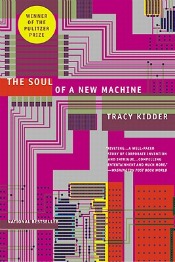
TOW #22 - The Soul of a New Machine by Tracy Kidder


     In the second half of Tracy Kidder's book, The Soul of a New Machine, the author delves into the struggles and the pains the "Hardy Boys" and the "Microkids" (the two engineering groups working on the computer project). By describing the events that take place at Data General Corporation, Kidder's book talks as much about computer engineering as it does about the engineers working on the enervating task of building the next "modern" computer. The men have to put up inadequate equipment, tightly closed rooms, and even unpaid overtime shifts. One member even felt over-pressured, which forced him to give up, move to Vermont, and avoid the situation overall. However, the remaining weary, yet persevering, engineers continued working. At the end of the book, the author himself joins these groups in their computer trade show in New York to present their work. Though no "technological revolution" occurred after such hard work, these young men were finally able to relax, knowing they were able to accomplish what they worked for.
     Through the story, Kidder uses vivid imagery and various anecdotes to encourage children and adults to be persistent in their work, even through all the challenges that await them. Not glossing over the mass chaos and the plenty mistakes the engineers committed, Kidder incorporates detailed imagery to give his book a more personal aspect, adding to the story-telling element of it. By asking the engineers to present their experiences and provide stories, the author enhances the validity of the book, allowing the story to be told in another form rather than a narration. Combined, these strategies not only make for an interesting book, but also the ease of visualizing the exhausting situation these dedicated people had to go through.
      This Pulitzer Prize winner, Tracy Kidder, successfully achieved his purpose. Undoubtedly, The Soul of a New Machine presents unforgettable story that served to motivate its readers.


Sunday, March 16, 2014

TOW #21 - Visual Text: Neuro Bliss Bottles


     As you casually walk around Walgreens, Seven Eleven, or CVS, it is almost inevitable to pass by all the drinks lined up in the refrigerators. All the Arizona, Vitamin Water, milk, soda, and juice drinks are waiting to be bought. However, the one beverage that stands out the most is Neuro, particularly Neuro Bliss. 
      Neuro, started recently by entrepreneur and philanthropist Sanela Diana Jenkins, is a functional beverage that aims to provide consumers with the necessary vitamins and nutrients to get each and every one of them through their day, as shown through its descriptive names: Daily, Bliss, Passion, Sleep, and Trim. Made out of recycled materials, Neuro bottles have their own way of appealing to customers, allowing their sales to increase while benefitting buyers at the same time. 
     At first glance, the bright blue bottle of Neuro Bliss catches the shoppers' attention, making them stop walking to examine the unique bottle. The color of the bottle is powerful enough to because it stands out from all the other drinks surrounding it. Even the shape is unlike that of other bottles. By human nature, it is only natural for us to scrutinize things that are "out of the norm". But not only does its physical appearance appeal to consumers, but so does the text all over the bottle. The word "Bliss", which is the largest word present, followed by the words "reduce stress" makes the drink's purpose identifiable - to reduce stress. Further more, at the bottom of the bottle, it reads "35 calories" and "no artificial colors or flavors", promoting the healthiness of the drink. This itself has the capability of appealing to even the most health conscious buyers. This sounds like the perfect drink to potential buyers, but some start to question the validity of the drink, which will force them to turn the bottle around and read the text and the nutrition label on the back. The back explains the science behind such a wonderful product and reasoning as to why this drink works, which not only convincing consumers to buy this drink, but also establishes this brand's credibility as a health supplement drink. Their suspicion towards the drink is minimized and is the final factor leading people to buy this drink. 
     Even though this is a relatively new drink in the market, it has already started competing against other drinks. The healthy, attention grabbing, all-natural beverage gives constant messages to buyers about it benefits, which, in the end, convinces shoppers to buy this drink. Even I, who fell into the trap of its rhetorical appeal, bought this, showing Neuro achieves its purpose of selling its products and providing the public with a healthy lifestyle. 

Sunday, March 2, 2014

TOW #20 - Georgia Tech Freshman Convocation Speech by Nick Selby

Writing Goals:
Go back to the thesis and support analysis with concise detail

Reading Goals:
Analyze a piece that has a strong appeal to its audience


     When asked to name famous orators, common responses include Adolf Hitler, John F. Kennedy, and Ronald Reagan. However, one does not need to be famous political figure in order to give a memorable speech. Nick Selby, a Mechanical Engineer Major at Georgia Institute of Technology, presented the 2013-2014 freshman class with a convocation speech like none other. Rather than giving a bland and boring oration, Selby strategically employed simplicity, comedy, and music to welcome the new students to Georgia Tech and set them on the right track for college through his advice.
     Beginning his speech, Selby first reminds the freshman class why they are present and then gives a quick outline as to what he will say: the 10 things most important lessons he learned in his first year. Already, his audience foreshadows that they will be provided with mini anecdotes. Throughout his speech, Selby numbered his experiences by explicitly stating "One... Two... Three..." Simplicity in his speech was a major factor that allowed Selby's audience to easily distinguish between each "lesson", thus enabling him to achieve his purpose. Formatting his speech as a list breaks up Selby's overarching message into 10 smaller and more interesting topics, making every bit of advice clear and concise. This sets Selby up to send his message later in his speech.
     However, a speech as simple as a list would make it monotonous, probably putting everyone to sleep. In order to further the chances of achieving his goal, Selby includes comedy. He first advises students to call their mothers. At first, this was probably disregarded by many, but by adding, "just make sure there aren't screaming girls, loud music, and some guys yelling obscenities in the background," Selby puts smiles and laughter in the audience, subtly planting advice into the students' minds. In the middle of his speech, Selby modulated his voice and said, "I am going to build the Iron Man suit." Again bringing laughter, those words actually have a deeper meaning. His comic words encouraged students to be ambitious and to do the impossible, just as Selby sought to do at Georgia Tech.
     Near the end of his speech, Selby had dramatic music play in the background as he passionately screamed, "If you want to change the world, you can do that! You're at Georgia Tech. If you want to build the Iron Man Suit, you can do that! You're at Georgia Tech. If you want to play theme music during your convocation speech like a bad***, we can do that! We're at Georgia Tech." The music, complemented with his repetition, ended his speech strong, channeling his message to the audience - anything is possible if you are visionary. By playing music during his speech, which many would not think of doing, he demonstrated that a lot can be accomplished with effort.
     Nick Selby, a determined engineering student, successfully achieved his purpose of setting the 2013-2014 freshman class to be inspired and ambitious students. By exposing his audience with simplicity in his speech, Selby easily got his points across. Additionally, his comedy and music had a powerful appeal to pathos, making Selby's speech entertaining yet didactic. To conclude his speech, Nick Selby asked that students "brace [themselves] on a hell of a ride, on [their] way of becoming a hell of an engineer."


Sunday, February 23, 2014

TOW #19 - The Soul of a New Machine by Tracy Kidder


Tracy Kidder is a Pulitzer Prize winner of his book The Soul of a New Machine, a book about the creation of a new computer at Data General Corporation. Considered a literary journalist, Kidder has also won other awards such as the National Book Award for Nonfiction, Ambassador Book Award, Lettre Ulysses Award, and many others, establishing him as a significant and credible writer of nonfiction. In his book The Soul of a New Machine, Kidder narrates the experiences of the two design groups that are fighting to create a new computer than can compete with the VAX computer developed by Digital Equipment Corporation, which is dominating in the market of 32-bit computers. Kidder documents the conceptualization, design, and the implementation process that takes place at Date General Corporation and tells the story of the company's struggle through the experiences the design teams had to face. Directed towards those interested in engineering and computer science, this book portrays an important piece of the history of the development of the modern computer. However, Kidder's main purpose is not to inform his readers, but to motivate them not to give up when faced with a situation involving a crucial deadline and a near-impossible problem to solve. Throughout the first half of the book, Kidder attempts to achieve his purpose through anecdotes and imagery. The addition of anecdotes creates an atmosphere that makes it seem as if the reader is at Data General Corporation itself, which enhances the audience's reading experience. Complementing anecdotes is Kidder's imagery. The skillful use of adjectives and other methods of describing a situation/person promotes the reader's understanding of what is taking place and the obstacles the design groups have to go through. Combined, these devices attempted to achieve Kidder's purpose and, however, were not successful because the struggles in the book have yet to be impactful. However, I believe that in the second half of the book, Kidder will be able to achieve his purpose.


Monday, February 10, 2014

TOW #18 - Article: "Technology Must Prevent Texting While Driving, Say Doctors" by Douglas Main

No Texting and Driving

The cellphone, a device capable of placing calls, texting, and entertaining its users, is possibly one of the most dangerous gadgets ever developed. Douglas Main, a science and environmental journalist who contributes greatly to Popular Science and other science news organizations, recognizes the threat that cellphones pose on those who are able to drive since "cellphones are responsible for a quarter of all accidents in the U.S. Texting is particularly bad, since it serves as both a mental and visual distraction." Concerned about the plight technology these days has caused, Main conceptualizes various ideas that have a great potential of increasing a driver's safety. One such fix to this problem that Main suggests is by adding a sensor to the car that creates a jamming signal, preventing drivers from using their phones and driving unsafely at the same time. Drivers, young and old, need to understand the dangers of using their cellphones carelessly. However, they do not, and rather than raising awareness of this situation, Main proposes that it is best to create equipment for the betterment of the current predicament. To achieve his purpose of warning people of the hazards of cellphone use while driving and proposing ideas to ensure safety, Main includes statistics on driving and quotes from doctors. The addition of statistics in the articles creates a quantitative outlook for the readers of the article. By understanding the percent and number of people effected by this, readers who are drivers are subtly forced to become scared and worried, making the incorporation statistics a direct appeal to pathos. Furthermore, Main quotes various doctors who have similar viewpoints on the texting and driving dilemma. Quotes create a sense of professionalism, further strengthening Main's credibility while giving an insight to readers about the dangers of driving. Statistics and quotes were strong enough the achieve Main's purpose, making drivers more aware of their phone habits and convincing them to acquire technology that prevents such dangerous behavior. 

Tuesday, February 4, 2014

The Soul of a New Machine by Tracy Kidder


The nonfiction book I selected for the third marking period is The Soul of a New Machine by Tracy Kidder. Technology is rampant in today's society, and this book takes us through the experiences of a computer engineering team racing to design a next-generation computer at a fast pace under great pressure.

I chose to read this book because it stood out as something very interesting. It is interesting to learn about the roots, the history, and the significant events that eventually built up to current technology. By reading this book, I am hoping to not only learn about where my iPhone and computer came from, but also incorporate some of the anecdotes described in the book into my work in the future.